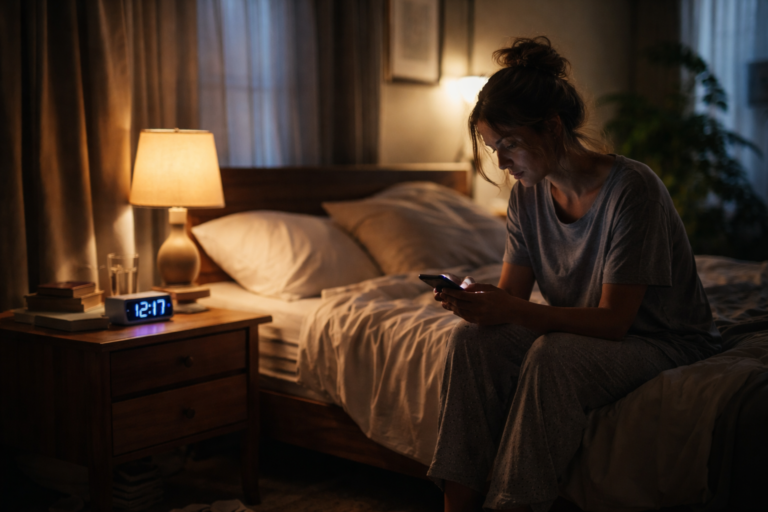
Why Falling Asleep Feels Easier on Some Nights
Some nights the bed feels like it’s been waiting for me all day. I lie down and there’s barely a gap between closing my eyes and drifting off. Other nights, even when everything looks the same — same sheets, same lamp turned off, same quiet house — sleep feels just out of reach.
It’s a small contrast, but noticeable. The difference between easing into the dark and hovering there, aware of the ceiling, aware of my own breathing. Nothing dramatic. Just a shift in how the night unfolds.
Why Falling Asleep Feels Easier on Some Nights is something I’ve thought about in passing, usually on the evenings when it doesn’t. The easy nights barely register. They slip by quietly. It’s the slower ones that get my attention.
In everyday life, this kind of night-to-night contrast feels like a common pattern. Most people I’ve talked to recognize it without needing to label it. It’s simply part of the rhythm of being human.
The Nights That Melt Away
On certain evenings, my body seems to know exactly what to do. I get into bed and there’s a soft heaviness behind my eyes. My thoughts blur at the edges. The day loosens its grip without much effort.
Those are usually the nights when the transition feels natural. There isn’t a clear moment where I “try” to fall asleep. It just happens.
Sometimes it follows a steady, ordinary day. Nothing special. Work, dinner, a bit of conversation, maybe some quiet scrolling or reading. Other times it comes after being physically active or spending a long stretch outside. The details vary, but the feeling is similar — a kind of gentle surrender.
It doesn’t feel earned exactly. More like aligned.
On those nights, I rarely think about sleep itself. There’s no internal commentary. My awareness softens before it can start analyzing anything.
The Evenings That Stretch Longer
Then there are nights that feel almost identical on the surface but unfold differently. I turn off the light and suddenly I’m very aware of the room. The faint hum somewhere in the background. The way the pillow presses against my ear.
My body might be tired, but my mind lingers. It replays a conversation. It wanders into tomorrow morning. It drifts, but not quite far enough.
The contrast isn’t extreme. I’m not wide awake. Just… present.
It’s interesting how subtle the shift can be. There’s no obvious reason. No dramatic event. Yet the sense of ease isn’t there in the same way.
In everyday experience, that’s often how it goes. The difference between falling asleep quickly and lying there for a while isn’t always tied to something big. It can feel random, even when it probably isn’t.
Small Changes In The Day
When I look back casually, without trying to dissect it, I sometimes notice small variations in the day that might have shaped the night.
Maybe I ate dinner earlier than usual. Or later. Maybe I had more conversation than I realized. Maybe I spent most of the afternoon sitting under artificial light instead of stepping outside.
None of these things scream for attention. They’re just part of daily routines. But the body seems to register them somewhere in the background.
There are days that feel mentally full, even if they weren’t physically busy. A long stretch of focused thinking can leave a different kind of residue than running errands or cleaning the kitchen. By bedtime, that mental fullness sometimes shows up as alertness.
Other days feel scattered, and by evening there’s a quiet craving for stillness. On those nights, sleep tends to arrive more easily, almost like relief.
Energy That Rises And Falls
Energy isn’t a straight line across the day. Some mornings start slow and build. Others peak early and taper off. By the time night comes around, the body carries that whole arc with it.
I’ve noticed that when my energy dips naturally in the evening — not forced, not pushed — sleep follows more smoothly. But when I get a second wind late at night, even a small one, it changes the feel of things.
It doesn’t take much. A lively conversation. A bright screen. An idea that sparks curiosity. Suddenly the quiet heaviness shifts into alertness.
And once awareness sharpens, it’s harder to slide into rest without noticing the effort.
The Role Of Attention
There’s also something about attention itself. On the nights when falling asleep feels easy, I’m not paying much attention to the process. I’m not monitoring whether I’m sleepy enough. I’m not checking the clock.
But on slower nights, attention turns inward. I notice the time. I calculate how many hours are left until morning. Even if I tell myself it doesn’t matter, the act of tracking seems to keep me slightly more awake.
It becomes a quiet loop: noticing, thinking, noticing again.
Many people describe this kind of awareness as familiar. The more we observe ourselves trying to fall asleep, the more elusive it feels. Not in a dramatic way. Just subtly delayed.
It’s almost like sleep prefers not to be watched too closely.
Environment That Feels Different, Even When It Isn’t
The room might look the same every night, but it rarely feels identical.
Temperature shifts slightly. The air feels heavier or lighter. Outside sounds come and go. A car door slams in the distance. Wind brushes against the window.
Some nights, these details fade into the background. Other nights, they stand out.
I’ve had evenings where the house feels especially still, and that stillness wraps around me in a comforting way. Then there are nights where the same quiet feels almost too quiet, making every small sound more noticeable.
The environment doesn’t need to change much to influence how the night unfolds. It’s more about how it’s perceived in that moment.
The Weight Of The Day
There’s also an emotional texture that lingers after the day ends.
Even ordinary days carry a tone. Some feel light and complete. Others feel unfinished, like a sentence that trails off. When the day feels resolved in some small way, sleep tends to follow with less friction.
But when something remains open — a thought, a task, a conversation — it can hover at the edges of awareness once the lights go out.
It doesn’t have to be serious. Even mild anticipation about the next morning can shift the feel of bedtime.
This is part of the broader sleep and recovery rhythms many people notice over time, where rest doesn’t exist in isolation. It reflects the tone of the day that came before it.
Routine Without Rigidity
Daily routines often look steady from the outside. Brushing teeth, dimming lights, setting an alarm. The same sequence repeats.
But the internal experience of those routines changes. Some nights they feel grounding. Other nights they feel rushed or mechanical.
When the transition into bed feels gradual, almost unremarkable, sleep seems to slip in more easily. When the shift from activity to stillness is abrupt, there’s sometimes a lingering buzz.
It’s not about doing anything differently. Just noticing how the pace of the evening shapes the mood of the night.
Why The Contrast Stands Out
What’s interesting is that we rarely question the easy nights. We accept them. It’s the slower ones that invite reflection.
The contrast makes us aware that falling asleep isn’t a switch. It’s more of a dimmer, influenced by dozens of small, mostly invisible factors.
That’s probably why Why Falling Asleep Feels Easier on Some Nights lingers as a quiet curiosity. Not a problem to solve. Just a pattern to notice.
In everyday life, sleep moves with the rest of our routines — shaped by light, conversation, movement, thoughts, and timing. Some nights those pieces line up gently. Other nights they don’t quite settle at the same speed.
And then, without warning, the pattern shifts again. A night that starts slow eventually softens. A week of easy drifting gives way to a few restless evenings. The rhythm keeps changing.
Over time, I’ve come to see the variation as part of the experience rather than an interruption of it. The contrast itself feels human.
There’s something almost reassuring in that. The body doesn’t repeat itself perfectly. It responds, adjusts, and moves through subtle cycles that aren’t always obvious in the moment.
Some nights we melt into sleep. Some nights we hover before it arrives. Both seem to belong to the same quiet pattern, unfolding one evening at a time.

Robin Abbott is a wellness and lifestyle writer at Healthusias, focusing on everyday health awareness, habits, and life optimization through clear, non-medical explanations.